

We build AI Fluency Accelerator.
Coincentives Labs builds AFA, an AI-powered system that measures, grows, and proves AI Fluency through real human–AI collaboration.
Become AI-fluent. Build stronger AI-augmented teams.
Coincentives Labs builds AFA, an AI-powered system that measures, grows, and proves AI Fluency through real human–AI collaboration.
Coincentives Labs builds the AI Fluency Accelerator (AFA) — an AI-powered system for measuring, growing, and proving AI Fluency through real human–AI collaboration.
We define AI Fluency as the ability to govern the consequences of collaboration with AI: how well a person collaborates with AI, how good the results are relative to the goal, and how responsibly risks are handled along the way.
Our deeper research spans human agency, cognitive augmentation and dependency, incentive design, verifiable credentials, and spatial learning. Those foundations inform AFA; they are not separate commercial identities competing with it.
Every technological era changes what we can do — but incentives shape what we repeatedly choose to do.
As AI scales into analysis, synthesis, and decision cycles, the critical challenge is no longer adoption — it’s whether accountability, agency, and consequence governance scale with it. Without governed collaboration, short-term productivity can mask long-term fragility.
Innovation doesn’t scale through technology alone — it scales through collective behavior. And collective behavior is shaped by the micro-mechanisms of incentives: what gets rewarded, repeated, trusted, and institutionalized.
Every technological revolution promised a gain — greater productivity, efficiency, freedom, or intelligence. But each came with a cost that was quietly accepted, because the incentives made the trade-off feel worth it.
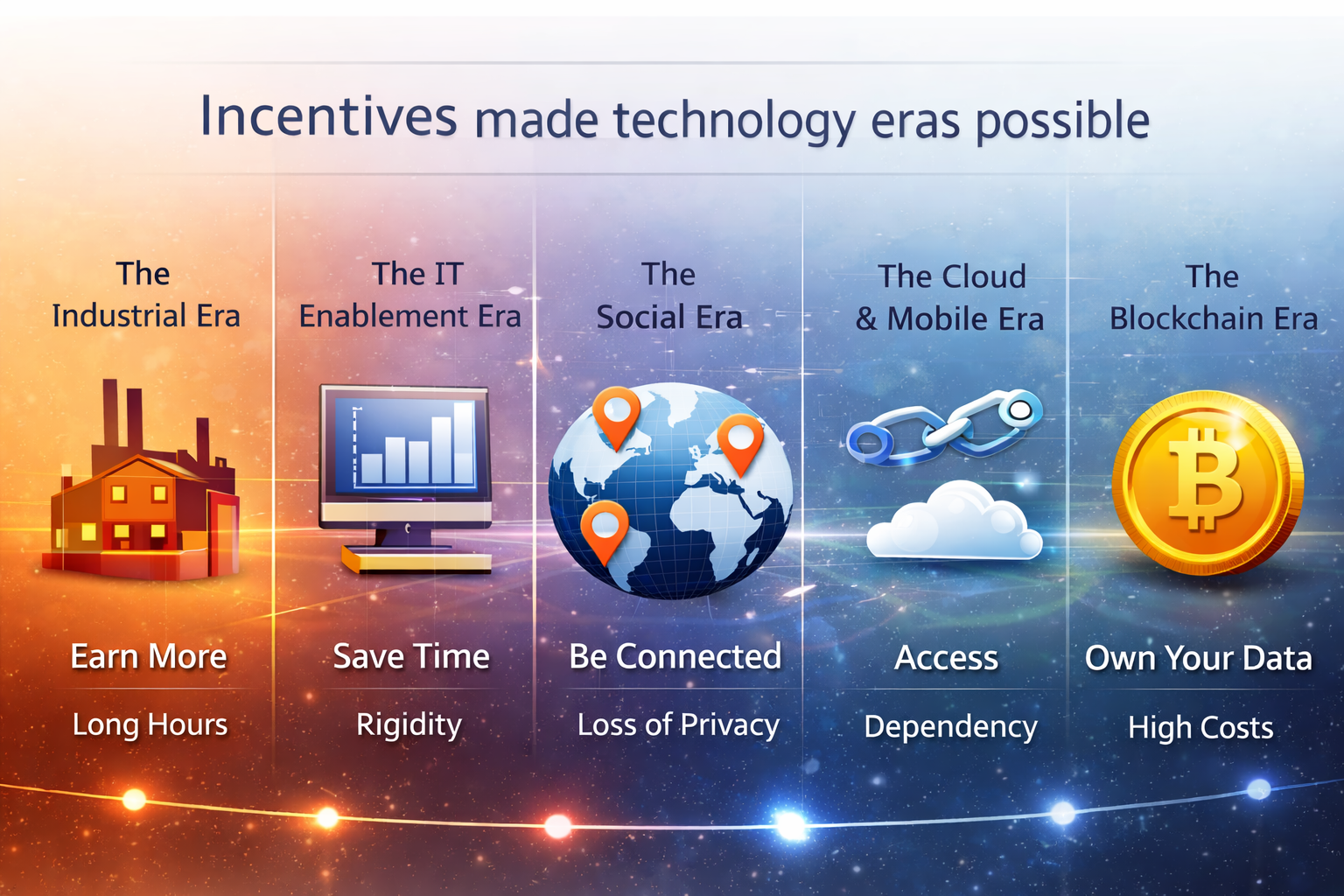
Incentives made technology eras possible — each breakthrough scaled by promising a gain worth its hidden cost.
Machines promised prosperity through productivity. But they demanded longer hours, narrower roles, and relentless repetition.
Incentive: Earn more by doing more.
Trade-off: Human balance for industrial output.
Computers promised accuracy and control but made organizations rigid. The loss of flexibility was justified by efficiency and cost savings.
Incentive: Save time and cost.
Trade-off: Adaptability for optimization.
Platforms promised free connection and global reach. But data extraction and algorithmic influence became the price.
Incentive: Be seen, be heard, be connected.
Trade-off: Privacy for visibility.
Ubiquitous computing promised seamless access, but created dependency — endless notifications, data capture, and algorithmic nudges.
Incentive: Simplify life through seamless access.
Trade-off: Autonomy for convenience.
Decentralization promised ownership and trust, but introduced complexity, fragmented UX, and high transaction costs.
Incentive: Own your identity, verify your truth.
Trade-off: Practicality for decentralization.
AI promises amplification — faster reasoning, creation, and execution. But ungoverned collaboration can diffuse accountability and erode independent reasoning over time.
Incentive: Ship faster. Decide faster. Do more with less.
Trade-off: Agency and consequence ownership for convenience and speed.
Each era scaled because its incentives aligned with human desire — for progress, status, ease, or control. But those same incentives also entrenched behaviors that made future change harder.
The next revolution will not be driven by a new technology alone — it will be driven by a new architecture of incentives that preserves agency while enabling governed collaboration at scale.
Technology changes what we can do.
Incentives shape what we repeat, trust, and institutionalize.
Auditable incentive mechanisms can make collaboration more governable, measurable, and trustworthy — so human agency compounds rather than erodes as capabilities scale.
We operate as a business innovation lab: independently designing product architectures, validating them through real deployment, and commercializing what proves resilient.
What scales becomes applied systems and credential infrastructure. What doesn’t scale becomes published doctrine — field essays, frameworks, and advisory playbooks that help institutions navigate transformation without sacrificing agency.
These foundations support the product system. They explain what we study and build from, while the public product path centers on AFA Coach, AFA Assessment, and Skill Accolades.
The central capability: governing the consequences of collaboration with AI. Product connection: AFA Coach and AFA Assessment.
Explore AI FluencyAuditable mechanisms that align motivation with durable value creation and sustained agency.
Explore Tokenized IncentivesPortable proof-of-skill signals that reduce trust friction and align recognition with evidence.
Explore Verifiable CredentialsImmersive learning environments that support experiential assessment, practice, and hands-on problem solving.
Explore Spatial ComputingCoincentives Labs builds AFA to measure, grow, and prove AI Fluency — so people can become stronger AI collaborators and teams can build balanced AI-augmented capability without sacrificing human agency.