1.0 AI Usage Is Assumed
Today, listing “AI experience” on a resume signals very little.
Employers increasingly assume candidates:
- Use ChatGPT or CLAUDE or similar systems in their day-to-day work
- Generate artefacts with AI
- Automate parts of their workflow
- Have AI certifications, course badges and workshop attendance
What they cannot see is whether the candidate can collaborate with AI without surrendering judgment. That distinction is the emerging hiring differentiator.
We refer to this as AI fluency — disciplined and deliberate human–AI collaboration that preserves cognitive sovereignty.
2.0 What is AI Fluency?
AI Fluency is the ability to think with AI and not through it.
AI Fluency is the disciplined, continuously improving governance of consequences in human–AI collaboration — ensuring both valuable outcomes and strengthened human cognitive capacity.
“Consequence” includes external impact (legal, financial, ethical, strategic, reputational) and internal impact (cognitive strengthening vs. cognitive atrophy through offloading).
AI Fluency ultimately determines whether human intelligence is enhanced through AI (cognitive augmentation) or quietly outsourced to it (cognitive offloading).
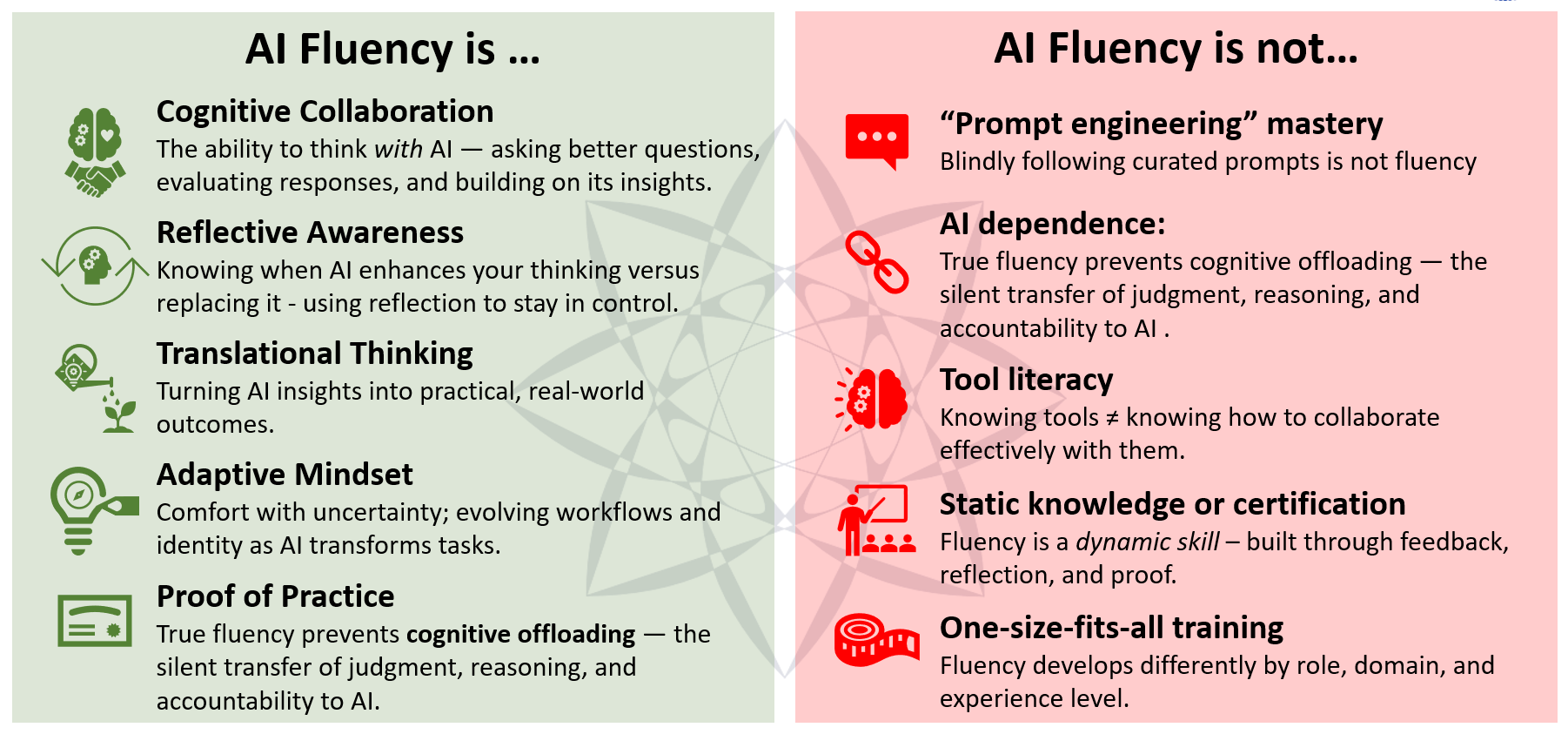
AI fluency is not what you know about AI — it’s how you govern collaboration with it.
For job seekers, AI fluency shows up as observable behaviors: framing, interrogation, refinement, and consequence governance—under time pressure.
3.0 The Hiring Signal Gap
Traditional hiring artefacts like resumes, certificates etc. have been good at depicting the outputs and achievements of an individual.
In the context of AI, these have not been able to reliably measure judgement:
- How a candidate frames intent before prompting
- Whether they interrogate AI outputs
- Whether they restructure flawed reasoning
- Whether they anticipate and govern downstream consequences
These capabilities matter in AI-enabled environments because AI amplifies both strong judgement and weak judgement.
The hiring market now faces a signal gap:
Traditional artefacts reflect output.
Employers need insight into judgment.
4.0 What Employers Actually Value in AI-Enriched Roles
Across product, strategy, analytics, marketing, and engineering roles, the differentiators increasingly include:
- Structured problem framing
- Assumption clarification
- Trade-off exploration
- Iterative refinement
- Consequence governance
These are not prompt tricks. These are collaboration behaviors.
A candidate who can articulate:
- “Here is how I refined the model’s reasoning”
- “Here is where I rejected its assumptions”
- “Here is how I governed downstream impact”
is significantly more credible than one who merely presents polished output.
5.0 Why AI Fluency Is Strategic for Job Seekers
AI is not just a productivity layer. It is a force multiplier.
In environments where output is easy to generate, differentiation shifts to:
- Judgment
- Discipline
- Structured reasoning
Candidates who develop AI fluency early gain:
- Interview clarity
- Stronger portfolio narratives
- Reduced employer uncertainty
- Higher trust
Your USP is no longer just delivering productivity gains. It is the ability to purpose-govern collaborations with AI.
6.0 From AI Familiarity to AI Fluency Proof-of-Skill
The next evolution in hiring signals will move from:
“I use AI.”
to:
“Here is measurable evidence of how I collaborate with AI.”
That evidence may include:
- Structured collaboration logs
- Iterative refinement traces
- Explicit governance inflection points
AI fluency, properly demonstrated, becomes an evidence backed signal of expertise — not just a claim.
7.0 The Strategic Implication
For job seekers, AI fluency is not optional.
As AI becomes embedded in enterprises:
- Shallow usage or knowledge based claims becomes invisible - lost in the noise.
- Verifiable evidences and proofs-of-skill of purpose-governed collaboration with AI become visible.
The candidates who can verifiably demonstrate AI collaboration quality — not just output — will differentiate in the crowded job market.