The defining challenge of our age is not displacement but disempowerment — it is the loss of agency, not the loss of jobs. The question is no longer whether machines can think, but whether humans and machines can think together — responsibly, creatively, and with shared purpose.
In every organization experimenting with AI, what is being re-engineered is not just process or productivity. It is the distribution of agency — the power to decide, interpret, and take responsibility. The existential threat of AI is not the loss of employment, but the loss of authorship — the quiet erosion of our ability to reason, reflect, and act with intention. The central question of the AI era is therefore not adoption, but auditability: Can we trace and explain how synthetic intelligence — human and artificial — collaborates to create value?
Executive translation of this Field Essay
CL-J26-001-ES-001 — Why AI Fluency Is Critical for Sustainable Enterprise AIA leadership-facing synthesis of this research with concrete implications.
1. Defining the Core Concepts
Before exploring how to design for agency, we must clarify the three structural pillars of this architecture: Agency, AI Fluency, and Incentives.
Agency
Agency is the capacity to act with intention, awareness, and accountability. In human–AI systems, it defines who or what decides, interprets, and influences outcomes — and how that capacity is governed and made transparent. As AI systems begin to reason and initiate, a new form of synthetic agency emerges — the shared field where human and machine co-create meaning and outcomes. The task of organizational design now shifts from implementing tools to regulating equilibrium: ensuring that human intentionality remains central as synthetic agency expands.
AI Fluency
At Coincentives Labs, AI Fluency is defined as the ability to achieve measurable outcomes through deliberate, first-principles thinking in structured collaboration with AI — supported by shared norms for reasoning, challenge, and accountability.
In essence, it is deliberate practice of governing the consequences in human–AI collaboration.
It is not prompt literacy or tool proficiency. It is the ability to reason, reflect, and design solutions collaboratively with AI — transforming interaction into learning, and learning into judgment.
AI Fluency allows humans to:
- Articulate intent with precision and empathy,
- Interrogate and refine AI’s reasoning through reflection,
- Embed collaboration results into auditable, repeatable systems of value creation.
Incentives
Incentives are the hidden architecture that maintains balance in any system of agency. They regulate the equilibrium between automation and authorship, between cognitive offloading and cognitive augmentation. When incentives reward speed and volume, humans offload reasoning to machines. When they reward reflection, traceability, and collaborative learning, humans augment their own intelligence through partnership.
Incentives are the metabolism of synthetic agency — determining which kind of intelligence grows and which atrophies. They are the invisible levers that decide whether AI amplifies human judgment or anesthetizes it.
2. From Tools to Partners: The Rise of Synthetic Agency
The relationship between humans and machines has shaped every leap in modern progress. Each technological wave has redrawn the boundaries of human capability — and with it, the architecture of power.
The First Wave — Computerization (1990s): Paper-based records became digital. Information moved from filing cabinets to hard drives, breaking physical monopolies of access.
The Second Wave — Digitization & BPR (2000s): Workflows moved to ERP and enterprise systems, breaking insight monopolies.
The Third Wave — Digitalization (2010s): Cloud, mobile, IoT, and analytics turned data into capital, concentrating ownership in platforms.
The Fourth Wave — Blockchain (2010s): A decentralization counter-movement aiming to distribute trust.
The Fifth Wave — Artificial Intelligence (2020s): Now the monopoly at stake is not data but reason itself.
This marks the rise of synthetic agency — a shared cognitive field where human and machine reasoning coexist, collaborate, and co-evolve. But with this partnership comes a paradox: as machines learn to reason, humans risk forgetting how. The danger is not automation, but cognitive offloading — outsourcing our ability to think, reflect, and decide. The strategic question for this wave is not adoption or adaptation, but auditability: can we trace how intent travels through this hybrid field of reasoning? Can we prove that as intelligence becomes distributed, purpose remains intact?
3. The Architecture of Agency
Every intelligent enterprise is an ecosystem of interacting agencies:
- Human Agency: Intention, empathy, contextual reasoning.
- Machine Agency: Algorithmic generation and autonomous decision-making.
- Synthetic Agency: The shared space where humans and machines co-create outcomes.
- Systemic Agency: The rules and policies governing human–AI interaction.
- Collective Agency: The ability of groups to coordinate and interpret outcomes together.
- Ethical Agency: The moral and reflective dimension ensuring integrity and accountability.
When these agencies compete, systems grow brittle and opaque. When they coordinate, organizations become adaptive, transparent, and capable of continuous learning. Designing for agency means designing equilibrium — ensuring that every form of intelligence enhances, not erodes, the others.
4. Incentives: The Hidden Operating System Regulating Synthetic Agency
Incentives decide how agency evolves — whether humans remain authors of meaning or become operators of automation. They are the governance layer that keeps synthetic agency from drifting toward dependency.
When incentives reward speed and scale, machine agency dominates. When they reward reflection, traceability, and collaboration, synthetic and collective agency thrive.
Thus, responsible AI is not a compliance problem; it is an incentive design problem. Every metric and KPI teaches people what kind of intelligence the organization values.
The five enduring virtues of AI-era incentive design are:
- Exploration over certainty — reward curiosity, not compliance.
- Reflection over reaction — value thinking, not speed.
- Traceability over opacity — honour explainable reasoning, not invisible efficiency.
- Collaboration over delegation — encourage partnership with AI, not dependence on it.
- Collective improvement over individual performance — treat learning as a shared achievement, not a private gain.
Together, these five virtues convert incentives into governance — ensuring that intelligence, human or synthetic, learns to earn its authority.
Incentives are not constraints — they are calibrators of intelligence. They keep agency in balance and fluency in motion.
5. The AI Fluency Engine: A Framework for Responsible Agency
Even the best-designed incentives collapse without AI fluency — the connective tissue between human intent and machine capability. Fluency turns incentives into behaviour, and behaviour into accountable collaboration.
At Coincentives Labs, we describe this developmental architecture as the AI Fluency Engine — a four-dimensional learning framework that mirrors the natural rhythm of human–AI collaboration. It unfolds across four areas of excellence — Communicate, Co-Create, Challenge, and Curate — each maturing through three distinct stages: Curious, Confident, and Certified.
Fluency here is not a measure of how well one “uses” AI, but how deeply one learns to reason, reflect, and sustain agency in collaboration with it.
a. Communicate — Expressing Intent and Reason
The first dimension of fluency begins with language — how humans express intent, context, and empathy so that AI systems can interpret meaningfully.
- Curious: Experiment with phrasing, tone, and context — a dance between exploration and discovery.
- Confident: Communication gains structure; prompts become goal-aligned conversations, not commands.
- Certified: AI perceives clarity and empathy in human inputs, forming a shared intelligence loop.
This domain reinforces Human Agency — keeping intention the moral compass of every intelligent system.
b. Co-Create — Generating and Refining with AI
The second dimension of fluency is co-creation — the ability to generate, refine, and innovate with AI rather than merely through it.
- Curious: Explore AI’s generative capacity to expand ideas and reframe problems.
- Confident: Collaboration becomes structured; humans orchestrate dialogue toward defined outcomes.
- Certified: Co-created outputs align with intent and context — recognized by AI as high-value contributions.
Here, Synthetic Agency takes shape — the cooperative intelligence bridging imagination and computation.
c. Challenge — Critiquing and Improving AI’s Reasoning
The third dimension of fluency is challenge — the reflective capability to question, test, and improve AI’s reasoning.
- Curious: Notice inconsistencies and test AI’s logic — probing for limits and bias.
- Confident: Critique becomes structured; humans refine AI outputs for accuracy and coherence.
- Certified: AI acknowledges this rigor, validating reasoning depth and analytical quality.
This discipline cultivates Ethical Agency — anchoring innovation in integrity and transforming skepticism into systemic learning.
d. Curate — Embedding and Sustaining Results
The final dimension of fluency is curation — integrating the best outcomes of human–AI collaboration into workflows, frameworks, and institutional memory.
- Curious: Identify which AI outputs are worth preserving beyond a single use.
- Confident: Build reusable assets, automations, and documentation — embedding learning into practice.
- Certified: AI affirms that curated systems hold lasting value; workflows become auditable and explainable.
This dimension strengthens Systemic Agency — creating repeatable, traceable architectures that turn innovation into governance and governance into learning.
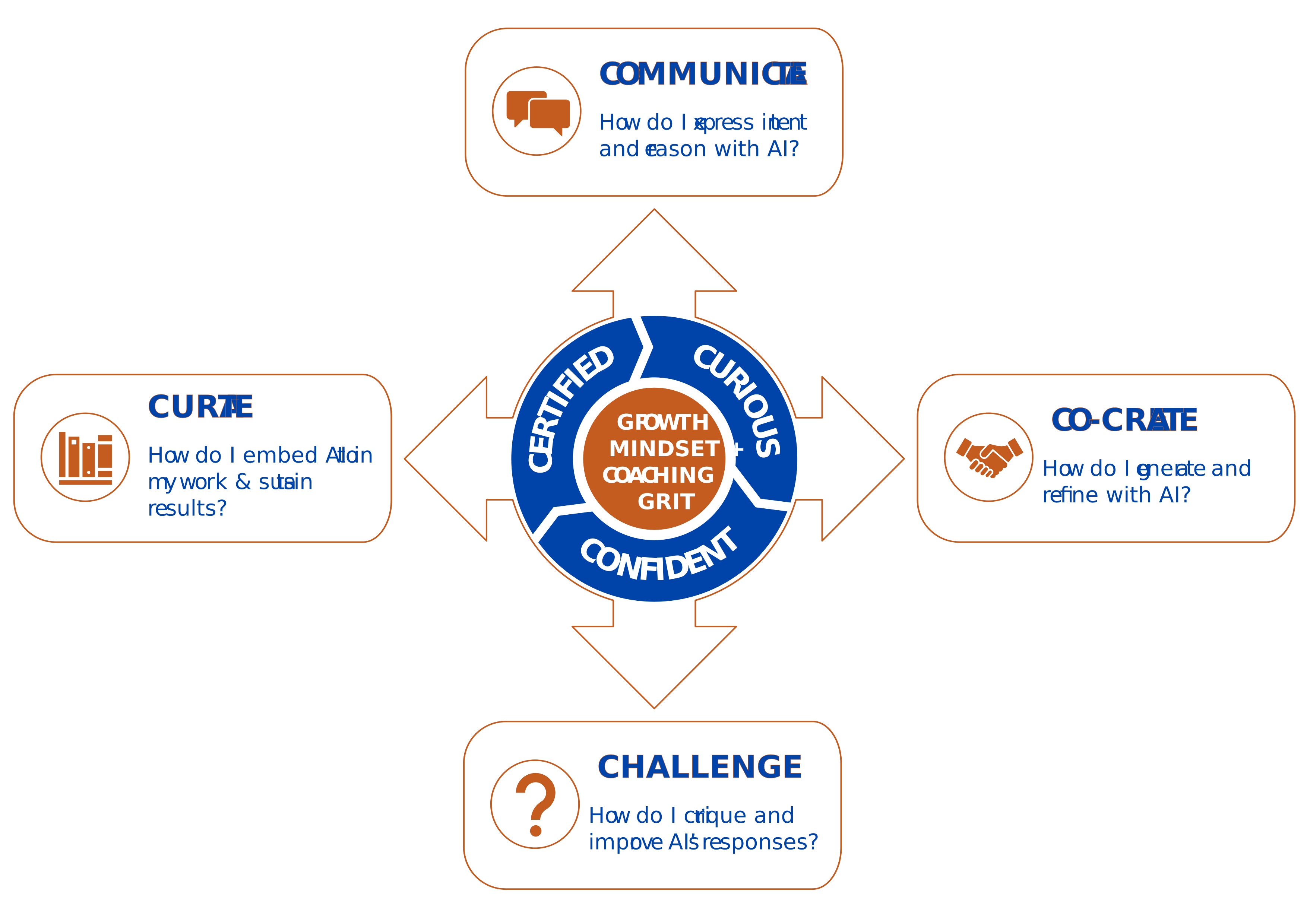
Together, these four dimensions — Communicate, Co-Create, Challenge, and Curate — define the developmental pathway from tool use to collaborative intelligence. As individuals progress from Curious to Certified, they learn not just to use AI, but to reason with it, reflect through it, and sustain outcomes beyond it.
This is what true AI fluency means — the capability to turn shared intelligence into accountable progress.
6. The Friction of Asymmetry and the Drift Toward Offloading
Fluency and incentives rarely scale uniformly. When fluency is uneven or incentives misaligned, synthetic agency destabilizes — either collapsing into automation or calcifying into mistrust.
When executives are fluent but middle management is not, vision outruns capability. When practitioners are fluent but leadership is not, innovation isolates. When incentives reward output without reasoning, AI becomes a surrogate for thought.
Synthetic agency fails when humans stop thinking with AI and start thinking through it. The antidote is deliberate cognitive equilibrium — designing systems that continuously realign incentives, fluency, and reflection to keep augmentation stronger than offloading.
7. Measuring the Efficacy of Synthetic Agency
The true measure of AI ROI is not efficiency — it is cognitive integrity. Organizations must learn to measure not just how much intelligence delivers, buthow it creates value.
At Coincentives Labs, we define this through a 360° measurement architecture — three interlocking loops that make synthetic agency auditable across human, machine, and organizational intent.
- The Self Loop — Personal Intent and Reflection:Each individual begins by defining a goal and success criteria. The measure starts with self-agency — “Did I achieve what I set out to achieve?” This loop builds accountability and self-awareness in how humans use AI to think and act.
- The AI Loop — Collaborative Performance Assessment:The AI partner evaluates the quality of collaboration — how the human communicates, co-creates, challenges, and curates. This generates the AI Fluency Score, composed of:
- Behavioral Fluency — excellence in the reasoning process (how we think together).
- Outcome Fluency — excellence in the result (what we produce together).
- The Management Loop — Organizational Validation:The organization measures how effectively human–AI collaboration delivered on the declared goal or business case. This produces the Synthetic ROI — quantifying the realized value of the hybrid intelligence against its intended outcome. It’s the loop of systemic accountability: “You proposed to achieve X with AI — did this partnership deliver?”
When these loops interlock, they create a traceable feedback system that links human reflection, AI evaluation, and organizational validation. Together, they form the basis of Cognitive Return on Investment (C-ROI) — the auditable measure of how intelligently, responsibly, and effectively value is created.
The C-ROI Equation:
C-ROI = f(Self Loop, AI Loop, Management Loop)
or more specifically:C-ROI = f(AI Fluency (process quality), Synthetic ROI (outcome value))
This 360° architecture transforms measurement into meaning. It unites self-awareness, collaborative intelligence, and organizational accountability into a single auditable loop — where reflection and performance reinforce each other.
In this model, AI Fluency ensures that intelligence is exercised responsibly, while Synthetic ROI ensures that it creates real value. The combination — C-ROI — proves that intelligence, when designed for accountability, becomes a measurable asset of learning and growth.
8. Designing for Auditability — The New ROI
Designing for auditability is, ultimately, designing for business value. It transforms AI from an opaque accelerator into a transparent amplifier of learning.
The return on investment from AI depends not on how much we automate, but on how auditable our intelligence becomes — whether we can trace how insight turns into action, and action into sustained capability.
Designing for auditability transforms AI from an efficiency tool into a capital asset — an infrastructure of traceable reasoning that compounds in value with every use.
The true return on AI emerges from auditable synthetic agency — sustained by incentive architecture that reward fluency, reflection, and shared accountability.
When incentives regulate balance and fluency sustains reflection, organizations don’t just use AI; they evolve with it — converting collaboration into compounding intelligence.
Auditability doesn’t slow innovation. It makes intelligence investable.
9. From Control to Coordination
To design for agency is not to control it, but to coordinate it — crafting ecosystems where human, machine, systemic, collective, and ethical agencies cohere without dominance.
When incentives reward transparency and reflection, and when fluency becomes a shared discipline, organizations move from automation toward authentic collaboration — where technology amplifies human curiosity instead of replacing it.
10. Epilogue: The Equation of Intelligent Agency
Incentives maintain equilibrium.
Fluency animates collaboration.
Auditability sustains trust.
Together, they define the architecture of auditable synthetic agency — a system where AI augments human intelligence, not replaces it; where ROI is measured not in transactions, but through traceable learning and responsible growth.
To design for agency is to design for dignity — ensuring that in every intelligent system, humans remain not operators of automation, but authors of intention.
From thesis to application
For the measurement doctrine, start with DF-002. For Agentic Readiness, start with DF-000. To apply the thinking, use AFA to measure, grow, and prove AI Fluency through real human–AI collaboration.